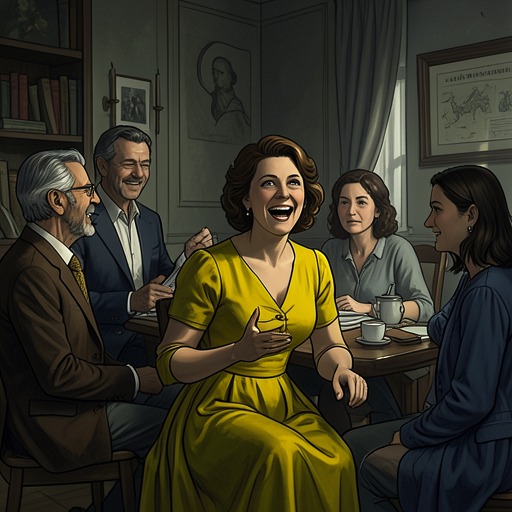
“Theme matters!”
People We Meet on Vacation“Theme matters!” is the playful rule Poppy Wright and Alex Nilsen use to turn their New Orleans holiday into a shared performance. What begins as a dramatic defense of a themed itinerary becomes a refrain for coaxing one another into unfamiliar experiences—and a compact expression of the ease and oddness they bring out in each other.
Origin and Structure
The rule emerges as Poppy and Alex wander New Orleans, drinking Sazeracs, hurricanes, and daiquiris as they move through the city. When Poppy tries to order a gin and tonic, Alex insists, “Staying on theme matters,” making the trip’s chosen atmosphere sound like a principle that must be upheld. The small disagreement supplies their “mantra” and helps establish the alter egos they will inhabit for the week.
Those personas are Gladys and Keith Vivant, a Broadway power couple imagined as performers to their cores. Their matching tattoos read, “All the world’s a stage!” The pair treat the identities as more than names: they begin each day with acting exercises and keep to one prompt for a whole week, allowing it to guide their interactions as they try to inhabit the Character. In this framework, theme is not simply a shared taste in drinks or destinations. It is a playful structure for deciding how to behave together.
The Rule in Practice
Poppy and Alex invoke the phrase when one of them resists the other’s suggestion. Their differences give the rule its comic usefulness: Alex is not keen to try the suede leather pants Poppy picks out in a vintage store, while Poppy is not eager to spend six hours in an art museum. Rather than resolve such differences by declaring one person’s preference more reasonable, “Theme matters!” turns reluctance into another beat in their shared act.
The slogan also accompanies outings chosen for their theatrical potential. When Alex refuses to enter a bar where an all-saxophone band is playing in the middle of the day, Poppy shouts the rule at him. On another occasion, Alex uses it when Poppy objects to buying matching shirts printed “Drunk Bitch 1” and “Drunk Bitch 2,” modeled on the familiar Thing 1 and Thing 2 design. They leave the shop wearing the shirts over their clothes. The result is not just a successful purchase: each has accepted a choice the other initially disliked, and both have made the resulting absurdity part of the performance.
The rule can also open a door rather than merely answer a refusal. Poppy leans into Alex and asks whether they can go to a country-western bar they passed, already convinced he will find the idea humiliating and will not want to go. Instead, he answers, “We have to. Theme matters, Poppy.” At the bar, saddles serve as seats and Kenny Chesney plays to the two of them. Alex is still chagrined at the prospect of sitting on the saddles, while Poppy tries to make her Sad Puppy Face at him. The phrase does not erase his hesitation; it gives them a shared reason to go anyway.
Reciprocity and Limits
The refrain works because it passes between them. Poppy uses it to push Alex toward the saxophone bar; Alex turns it back on her over the shirts and invokes it when she proposes the country-western bar. Its repeated use makes the rule less a unilateral demand than a mutually recognized bit of pressure. Either can appeal to the performance, and either can become the reluctant participant whose resistance makes the scene funnier.
Their exchange about eccentricity clarifies what the game makes possible. Poppy tells Alex, “I love when you get weird,” and he replies, “You make me weird. I’m not like this with anyone else.” His response links the invented roles to a real difference in their relationship: the performance lets him behave in ways he says he does not with other people. The rule is therefore both theatrical and relational. It creates a pretext for conspicuous silliness while revealing that their particular friendship makes that silliness feel safe and welcome.
The phrase does not make every comic escalation automatically acceptable. When Poppy starts to invoke it again, Alex puts a water bottle into her mouth and says that once she is sober, she will not think the joke is funny anymore. Poppy maintains that she will always find her own jokes hilarious, but concedes his point. The interruption supplies a limit to the game: its shared premise can encourage them to perform, but Alex can still stop a joke when he thinks the moment calls for it.
Significance
As a rule, “Theme matters!” gives the week a simple, repeatable dramatic engine. A preference or refusal becomes a prompt; the prompt tests whether either friend will join the other’s idea; and the attempt, successful or awkward, becomes part of the act. The phrase makes the trip’s chosen theme tangible through drinks, clothes, bars, and daily performance exercises, while its repetition turns ordinary negotiation into an ongoing inside joke.
Its deeper significance lies in the contrast between the exaggerated personas and the unforced intimacy beneath them. Gladys and Keith are invented, their weekly prompt is a game, and the slogan is deliberately overblown. Yet the play depends on a real mutual responsiveness: Poppy notices Alex’s unusual willingness to get weird with her, and Alex joins an outing she expects him to reject. “Theme matters!” thus names not only the logic of their holiday but also the particular freedom they grant each other within it.